
Our Near Future Might be Surprising
The realistic beginnings of a Dyson Swarm, humanity's new kingdom in space
WORLDBUILDINGMYTHSCIENCE
Vivek Menon
3 min read
In the Mahabharata, the architect Maya Danava builds Indraprastha, the "Palace of Illusions", as the dwelling of the elite. Its polished crystal floors looked like water while lotus-filled pools of water looked like solid ground. Walls of lapis drank the light, creating illusions of open doorways; gold pillars held up the roof; ivory-coral-and-conch staircases wound neverending among the vast halls.
It was the high-mark of the old civilization… and a trap that bred envy, in those that were tricked by the floors and reached for doors that were never there. That envy was enough to end the world.
In One Destroyer’s Dharma, there is no generic, stage-flat “Galactic Empire". Instead, Indraprastha is reborn with the same bewildering splendor and geometric beauty. But the architect's magic has gone. In its place is our own plausible, realistic engineering... things we can start building today.
The Worldrivers
A trillion humans can live comfortably inside our solar system, if you take it apart. Physicist Freeman Dyson imagined this nearly a hundred years ago. He named it the “Dyson Sphere”: a colossal shell around a star, vast enough to catch all its power. But a solid shell is hard to hold. It will drift, wobble, crack. The truer answer—the one that might plausibly be built—is a Dyson "swarm"*.
This is the inspiration for the Worldrivers.
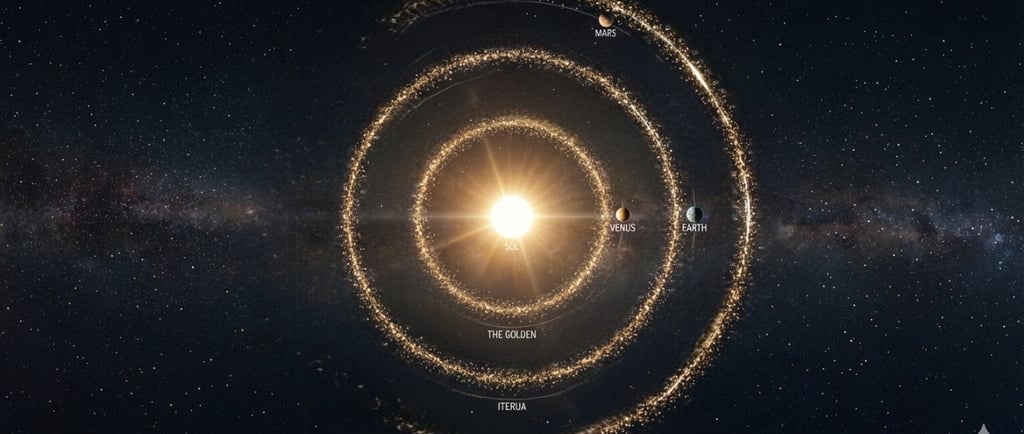
Picture it: millions of orbitals, strung like pearls along the endless glowing “Filaments” that act as the nervous system of a vast civilization. All of it flowing like a river in stately rings around the Sun.
There’s no need to terraform other planets, let alone spend centuries traveling to other stars. You take Mercury, unmake its sun-baked metal and diamond and spread it into a trillion solar captors that drink the Sun from every angle, turning it into current for industry and energy for everyone. You turn the asteroids into the bone and bedrock of endless new worlds: O’Neill cylinders like great bronze drums, Bernal spheres like drops of dew, toruses like vertebrae, worlds shaped like rings. You might even float immense mirrors near the Sun's poles, fanning more light from it like a giant bellow.
The Worldrivers are no far dream.
The Geography of Class
The currents of geography and society sort and divide the Worldrivers, into three great streams:
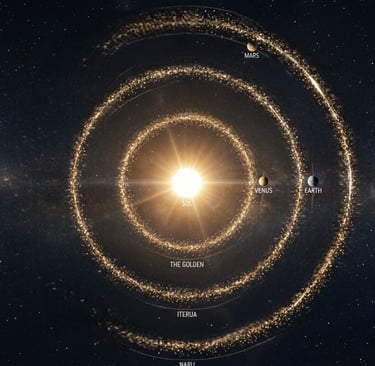
The Golden runs innermost, tracing the path of Venus. Here the sun bathes all, and behind it play those who can afford such engineering: the old dynasties, the corporate thrones, the Council's inner circle. Their orbitals gleam like jewelry.
Iterua is the eldest river, the longest and most traveled: the river Nile of the swarm. What Venus's Golden is to power, Earth's Iterua is to sheer human weight: half of civilization's two-hundred billion souls live and flow in it. From Earth it hangs in the night sky as a long, white cloud.
Naru runs farthest out, skirting the orbit of Mars, where opportunity meets exile. The sun here is a bright coin. This is where the strip-mining corporations stake their bases—where the ships go out to gut the gas giants for hydrogen, water, phosphorus, all the raw atoms a trillion bodies need and burn through and need again. The Council's law grows weaker at this distance.
In time, these three rivers will swell until they embrace the sun entirely—into three nested shells, a Dyson Swarm complete. Unless...
A Glittering Cage
In the Mahabharata, Indraprastha is lost in a terrible gamble, never to be recovered in the war that follows.
The Worldrivers are beautiful. But beauty is an illusion. The glitter is shielding against the pitiless Sun, the walls a crack away from the void’s rushing death.
And none of this is the true danger.
The true danger is the same as it was in the Palace of Illusions: human want, human envy, human suffering. The old heat: Trishna. The remarkable engineering of the Worldrivers can survive failures; whether they can survive their inhabitants is the question this story asks.
*Coined by futurist Isaac Arthur, another inspiration for One Destroyer's Dharma.
FAQ
While inspired by the glittering kingdoms of the Mahabharata, the novel's setting is grounded in known science. The Worldrivers rely on standard physics (gravity, orbital dynamics), planetary geology, energy flux, and resource management. These are ideas espoused by notable futurists; they are feasible within the limits of current technology.
Is the setting for One Destroyer's Dharma fantasy or sci-fi?
Reach out to discuss stories or collaborations
© 2025 Vivek D. Menon Writes. All rights reserved.
Blog
Ancient myths, future tech: dive deeper.