Ancient Nukes, Test-Tube Babies, and the End of the World
Why I really remixed the Mahabharata into Science Fiction
INSPOMYTH
Vivek D. Menon
3 min read

The Mahabharata is two thousand five hundred years old. When its first verses were spoken, Homer's songs of Troy and Ithaka rang fresh. Most know the ancient Indian epic for its kings and bitter family wars, for chariots wheeling in dust and blood, and flights of arrows.
But the poem runs to a hundred thousand verses and more than a million words. There are ships that fly through the cosmos, weapons that set fire to whole worlds. Soldiers wear augments that no weapon can breach, while a hundred children grow in jars outside the womb, row upon row like seedlings in a dystopian nursery.
Big Fish Must Eat Small Fish
While inspirational, such a techno aesthetic is not the reason I chose to remix the Mahabharata into science fiction. I chose to do so because the epic foretells what we are becoming.
We are eating up life on Earth, burning the air to a point we may no longer be able to breathe. Most of us see this, but we are not able to stop it. The Mahabharata saw it too, and named it a part of nature itself... where hunger for food, shelter, safety, drives all animals to survive, grow strong, and hold power over the land and sea beneath.
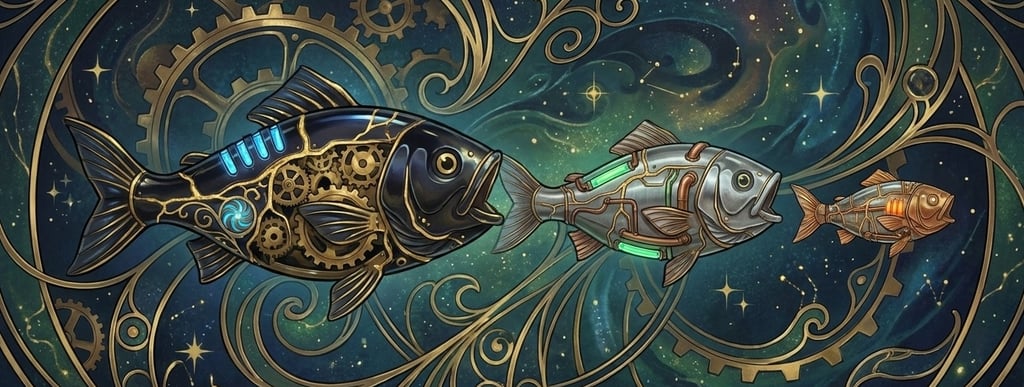
The epic named it the Law of the Jungle. All creatures to survive must take. The big fish swallow the small fish. Humans must eat too. No one here is wicked because the hunger is simply what we are.
Right?
"Day after day countless beings go to the abode of Death, yet those who remain believe themselves immortal." —Yudhistira, King-in-Exile
Today the Earth and all its life are on fire, and the techno-optimists offer answers with a wave and a smile: hang mirrors in the sky to shade us from the Sun, seed the oceans with iron to swallow the gases, pave the deserts with glass to catch the light.
Or we could just... flee. Who needs this one world when the riches of a million-million Earths wait to be stripped and flayed bare? In such a jungle, far from from our puny continents and thin nations, the new apex predators will grow teeth large enough to gouge planets. The oligarchs and leaders of powers atop the heap—all the new elite—will swallow worlds.
Duty Against Thirst
The Mahabharata reminds us that of all creatures, only we carry the fatal flaw of Trishna. The word means thirst, but not the kind water can satisfy. It is craving without end, where the question "Why do I want?" is forgotten against the relentless hunger. No civilization has avoided Trishna.
So what do we choose? Feed ourselves till we choke on our own world? Or carry our hunger out among the solar system, forget asking the question for... now.
The Mahabharata saw our blindness long ago. Their only answer was the countervailing force of Dharma, duty to the cosmic order that binds all creatures. In the epic telling, a god walked amongst the kings and warriors, spreading the law.
But out in the rocks and planets of our future, who will carry Dharma? What force, what being, will teach the hungry to restrain themselves?
FAQ
While technically an ancient epic, the Mahabharata contains advanced technology and ideas about society and humanity that are relevant to modern times, problems and grievances. In a sense, the epic is a precursor to the genre.
In One Destroyer’s Dharma, Dharma represents the cosmic law or "right duty" that opposes the chaos of unchecked expansion and resource extraction in the solar system. In ancient times, kings and warlords needed to be checked. In modern society, it might be nations, corporations or simply the elites that run them.
The answer is subjective. I enjoyed the first 3 books of Frank Herbert's Dune series (inspired by elements of Islamic and Indian mythology) and Roger Zelazney's The Lord of Light, both of which are set in a high-tech spacebound future.
Is the Mahabharata considered science fiction?
What is the meaning of Dharma in a science fiction context?
Best sci-fi books based on Indian mythology?
Reach out to discuss stories or collaborations
© 2025 Vivek D. Menon Writes. All rights reserved.
Official hub to decode the tech, worldbuilding and myths of Vivek's universe.